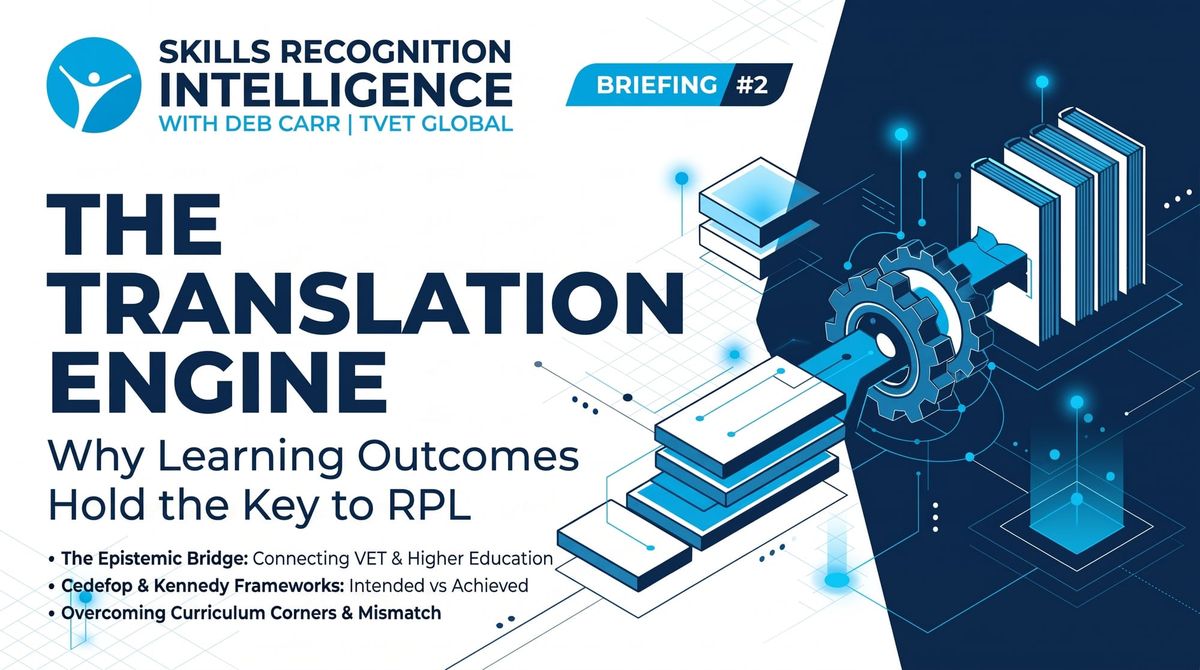
The Translation Engine: Why Learning Outcomes, Transparency, and Context Hold the Key to RPL
Executive Summary
Across the global skills landscape, Recognition of Prior Learning (RPL) is undergoing a major structural shift. No longer viewed merely as a local administrative mechanism for granting unit exemptions, RPL is increasingly recognised as an essential economic instrument for workforce mobility, lifelong learning, and social equity (Carr & Smith, 2025).
As Australia establishes the statutory Australian Tertiary Education Commission (ATEC) and rolls out Jobs and Skills Australia’s National Skills Taxonomy (NST), education leaders face a longstanding challenge: how to render experiential learning legible across different educational sectors without compromising institutional integrity.
This briefing demonstrates that while a national taxonomy provides a common vocabulary, transparent, modularised learning outcomes serve as the vital translation engine. When learning outcomes lack transparency, the entire recognition system breaks down, disempowering RPL candidates, enrolling students, hiring managers, and educational institutions alike.
Introduction
Welcome to Briefing #2 of Skills Recognition with Deb Carr.
This dispatch tackles a central challenge facing Australia’s tertiary sector today: how to connect Vocational Education and Training (VET) and Higher Education without diluting the distinct purpose or institutional integrity of either sector.
In our latest briefing, The Translation Engine: Why Learning Outcomes, Transparency, and Context Hold the Key to RPL, we explore how transparent learning outcomes serve as a neutral translation layer across the tertiary ecosystem.
Key Themes Explored in This Briefing:
- The Epistemic Bridge: How transparent learning outcomes reconcile VET’s horizontal occupational standards with higher education's vertical knowledge structures, supporting ATEC’s National Credit Recognition Framework.
- Intended vs. Achieved Outcomes: Following Cedefop’s framework, we differentiate written curriculum standards (intended outcomes) from validated workplace mastery (achieved outcomes), establishing how RPL validly evaluates uncredentialed experiential learning.
- Declan Kennedy’s Lens: Why educational leaders can move past abstract competency debates by expressing expected capabilities through clear, observable learning outcomes.
- Context, Specification, and Agency: How balanced, context-anchored outcomes prevent "curriculum corners" (DEWR 2024), build individual skills literacy, and foster learning agility in an AI-disrupted labour market.